Johnny Cocktail has been VERY busy!

There are many more posts to come so stay tuned. This Blog is getting ready to see quite the face lift!
Showing posts with label Whiskies. Show all posts

Thursday, March 8, 2012

The Scotch Reviews 1: Ardbeg 10 Year

In a Shot:  Big, smokey and filled with so much peat that the moss grows out of your mouth and evolves into an elaborate aggressive level of smoke that I would say it's for those seeking experience rather than those just enjoying a daily dram.

Ardbeg:  "The Ultimate Islay Single Malt Scotch Whisky, 10 Years Old, Non-Chill Filtered 46% ABV"


I have been very neglectful to my fans and aim to change things around here.  For those of you who have not been up to part with things, Johnny Cocktail has become Johnny Wine Guy and is day and night wandering the streets of Alexandria looking for new people to try famous wines in the pop culture market and still educating folks about the balance and beauty of excellent service, craftsmanship and a genuine appreciation for all things good, small or large.  I have on back order at least ten blogs and would like to begin producing them for my fans.  I'm not only going to be back but I'm bringing that original rawness found in some of the older posts back for a while to get me quickly back into the game.

The Next Rounds on Me in its title states "A DOSSIER of all things drinks & drinking."  I aim to make that a fact.  From now on, if I happen to taste anything whatsoever, whether brief or expansive, I will now begin posting information and opinions about them.  I told you Scotch tastings were coming and boy oh boy have they come and gone.  I will elaborate on those later but for now, lets start with one I had the privilege of trying this past year, courtesy of my recently returned to the states friend Brad, who gave me this as a gift, knowing I was a lover of all things peat moss related, particular whisky!

Located in the Islay region of Scotland, the small (in size but not in popularity) island just south west of the Isle of Jura, was originally a refuge for Celtic monks escaping the raiding Nordsmen was the home of illicit distillers making their whisky a midst a rugged and rocky cove.  The location was abundant in soft water, fertile soil and of course, precious acres of peat moss.  Back in 1815, according to a small family of tenant farmers named MacDougall, this was a location to begin building a distillery.  Close by the site of the long-abandoned Tallant distillery and just a little farther south, lies Ardbeg, a distillery where by 1853 was the biggest producer on Islay and the center of a 200+ community.

This place was described beautifully by Whisky Aficionado Michael Jackson; "Islay does not seduce you like other islands.  Instead, it invades and takes possession of you.  Its constant wind carries a mix of sweet, salt-laden air, the whiff of the sea, the coconut aroma of hot gorse, a hint of peat smoke and bog myrtle, and the smell of just-spent fire on the beach.  All the notes you pick up in its malts are there, floating in the Atlantic Wind." - Just brilliant!

On a small note about this place, it was huge in the 1850's.  It ended up with a horrible reputation for being the peatiest and almost undrinkable beast for a time and was primarily used as fillings for blends. It ended up closing the year I was born (go figure) and by the early 90's it was only running to make unpeated "Kildalton" malt, Ardbeg eventually became dilapidated.   1997 was the year where Glenmorangie (Yes, light, non-peaty, easy drinking Highland Glenmorangie) resurrected the distillery and has become a bustling location.  Yes, it is still famous for being a "Peat Monster"

Ardbeg has been awarded the best distillery in the world, three times in a row.  It is unique in many ways.  For one, it's declared by many, the peatiest and smokiest Scotch in the world.  Typically most whiskies are chill-filtered and reduced to a strength of 40% ABV.  Ardbeg Ten Years Old, however, is non chill-filtered and has a strength of 46% ABV.


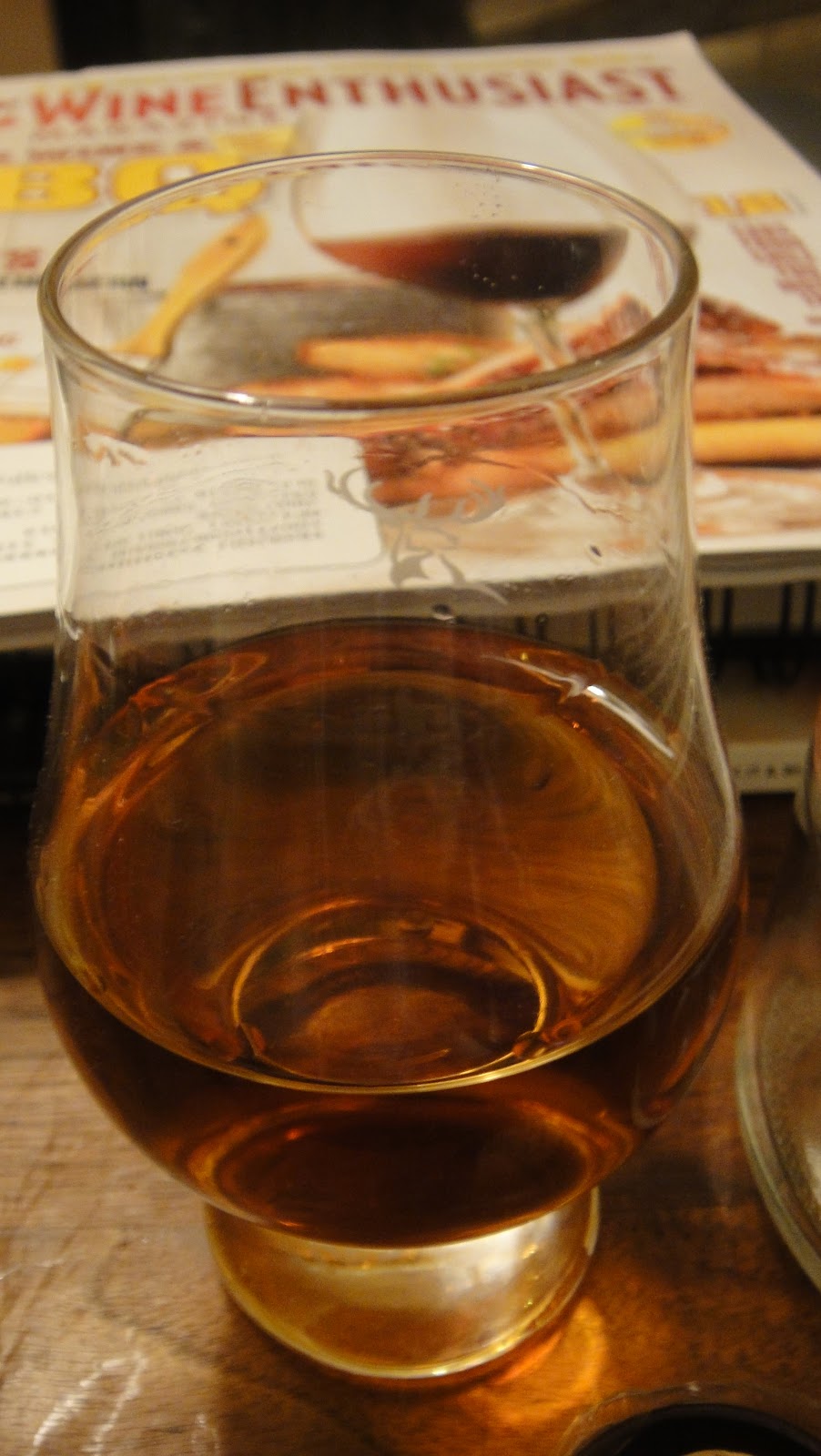
And boy is she is deceiving.  Ardbeg 10 Year Old truly looks light in presence, but has an oiliness from her fresh barley grain, slightly mustard yellow complexion that tells me that there is something darker and far more developed than anybody else her age.  It almost appears virgin olive oily without even allowing it to move.  The nose, reveals an intense level of peat moss, brine and smoke. 

It is best described as a beach fire put out by the sea itself and the smoke that arises from it, is the truest form of this dram.  In the mouth it is heavy and sharp, as the relatively moderate finish arrives, multiple layers of smoke and heat follow.  The heat finishes far quicker than the taste of oil and peat does, it truly feels as if this flavor, if you do not drink or eat anything else, will follow you for the rest of the day. 

It is aggressive, assertive, bold and a bruiser of a dram and I highly recommend it for anybody looking for an experience, but not for anybody looking for a casual libation.  It's definitely one of my favorite mass market Scotches.  I must give praise and thanks to Mr. Rainwater for giving me an opportunity to enjoy this specimen, it is a true experience of a spectacular whisky - I hope to explore more like this VERY soon.

We'll talk again soon y'all, this weekend I'm participating in a serious Rum tasting.  It will make quite the blog entry!

Cheers!

Saturday, July 2, 2011

GNV TO THE SEA - Four Roses: A Very Special Single Barrel

In a Shot:  During a private invitation to Gerry and Victoria's house, I am given a very unique Bourbon with a very special sentiment.


It's amazing who you come across in this business, simply by standing still.  It amazes me every time how people like Yoko will suddenly give me a bottle of Tombo Sochu (Delicious Japanese vodka) or when Jen gave me that bottle of Awamori (Lovingly called Snake Juice, spirit aged in a process using poisonous snakes).  Some of the most fascinating treats from them, I thank you for your love and support.  Then there are those who are home bread and homeward bound.  They present me not only with things from this country, but things that are only exclusive to regional aspects of our land.  It doesn't happen all the time, but every once in a while, something ironic/iconic like this happens.

A very exclusive, extremely unique and quite honestly personal dram, presented by a man who invited me into his house for a final sit down and drink before leaving under his guiding wing in his restaurant we all know has, since this post, locked it's doors indefinitely;  I present to you, the Four Roses Single Barrel Tasting Notes:

Drinking from a bottle Gerry Hebert gave me, sold exclusively at Schneider's of Capitol Hill (Fine wines & spirits) hand selected and bottled from Warehouse DS, with a 35% rye Mashbill / delicate fruity yeast:  February 18th 2011 (the month and day my wife Mary and I were married and held a reception in Gerry's restaurant only three years prior).  Aged 8 Years and 9 Months settling in at 100 proof.  A bottle (Number 2-4K) whom I'm sure Four Roses and quite possibly the Heberts had NO idea sang such poetry in our hearts and hearts.  So to you both, this Next Rounds on Me!

First glance the dram appears a burnt copper in color.

Strong ethanol at first reminding me of a hospital.  But allowing it to oxidise, simply nosing it over a span of ten minutes there are evolutionary changes.  With time to breath; Toasty oak and tart raspberry (Definitely found through the small amount of rye present and as affected by the choice of yeast), there are notes of dried dark red fruits and even canned peaches.  The mouth is coated with a warming hard candy flavor.  It takes it's time to finish, allowing it's spine tingling warmth to overwhelm the entire palate, though it sharply stings the sweet area of your taste buds.   A dusting of Hershey's milk chocolate and butter are overlapped by the expected flavors of caramel and an extra creamy vanilla.  Over time, the heat dissipates and the drink becomes remarkably smooth for a dram packing 50% ABV.

I've conducted this tasting under my usual circumstance.  A washed face, washed hands, blown nose with crackers eaten prior to the experience and lots of water  in between each section of the tasting.  This is my very formal way of creating my dossier of each drink I consume, but with Gerry and his wife Victoria, the experience was far more casual.


We enjoyed this dram prior to Gerry getting a knee surgery.  The man ate the most insane dinner and dessert that night, as if he would never be allowed to eat again, ever.  His plan was to polish off this entire bottle of single barrel by the stroke of midnight, after which if he consumed anything, would develop into a cocoon and hatch the next day a terrible Gremlin.  We sat in his living room listening to old tunes on the radio, Gerry was capable of calling out each and every band within the first 4 seconds of each song playing and we spoke about Cape May and the longevity of our relationships.  We spoke about folks in Cameron Station, Alexandria VA, a community that "rose" out off a military base that became it's own township, if you will.  We, the people of Food Matters became it's central hub.  It was experiences such as this and the times my wife and I spent at "GNV's" beach house in Cape May or the catering's to Gerry's office, or that time I went to the Masonic temple and Gerry was attempting to buy a trip (all for charity mind you) to some island or boat trip somewhere and he was up against one of America's homeland security top execs and lost "Hoping she simply just ran out of money!" from all the other bids she won.

It has been great times and Gerry's energy is something in his age, I strive for in the next five years!  He's been a father figure to me and a breath of fresh air.  I hope I've done him proud and I thank him for all that he's ever done for me.  Let this small tasting be my sentiment to him and Victoria, who helped mold me into the community supporter I am today.  I hope to make my mark as strong as I did in your community in the next place, wherever that may be.  Blessings and good times.  I say, thank you.


Cheers and with Love,

Johnny Cocktail

Thursday, March 31, 2011

Midleton Very Rare 2007

In a Shot:  In connection with an anonymous spirits provider, I have been given an opportunity to taste the soft, smooth, preserved fruit predominant 2007 vintage of Midleton Very Rare Irish Whiskey.


It's late here folks, so let's get right down to business.  Beautifully light in color.  Honey comb or pale copper at best.  The smell is what gets me more than anything.  The whole thing smells of preserves.  A combination of peach, apricot and strawberry  surround the nostrils before even letting ethanol come into play.

A seductress, beautiful to the eye and sweet to the senses.  I'd have her for breakfast at sunrise!  Light notes of nutty caramel, honey and cereal is there with a machine oil undertone with the faintest hint of oak.  You know you are dealing with something special here once it enters your mouth.  Dense and heavy  it feels like it sinks to the bottom of your vocal cords before entering your warming stomach only to leave with the utmost of docile finishes.  Truly soft and almost short but commanding in it's own way.  Yet going back to it, it feels light on the taste buds, regardless of its gravity.  After almost an hour of breathing there are spikes of acid, hints of chocolate, mushroom and also Graham cracker notes that were not previously present.

The big show stopper is that fruity nose though, it really smells like a Virginia summer happening in an Irish barley field!  I can only imagine what each vintage presents and can only get excited about the next one.

Some people will ask if the price tag is worth it.  Here's what I say:  In this bottle you will get at least four of your daily fruits plus one of your drams along the way without a burn to give any notice.  Decide for yourself if there is a price on that and avoid giving a single malt with a permanent age marker based on bias, this only starts at five years but they keep putting older stuff into this mix each year, so it only gets more complex and it will only get better.

Cheers!

Wednesday, March 30, 2011

Irish Whiskey Tasting

In a Shot:  Hosted my first Irish Whiskey tasting and tended a shut out bar with special guest, Atena Moore.


Let me begin this one by stating, I have found a huge new appreciation for Irish Whiskey.  Our country has trained us to be one of three things.  A huge and bias brand loyalist, a cultural or geographical pride zealot or a media/class elitist.  In other words, if you are proud to be an American, drink your Bourbon and bourbon alone otherwise you'll drink only your Johnny Walker Blue Label because your TV and the price tag says it's the best of the best or turn your nose at anything that isn't Single Malt Scotch because, well, it isn't Single Malt Scotch.  At one point or another, everybody is one of these people, including myself.  I've had roughly four bottles of Johnny Walker Blue Label come and go in my household and have been to tastings such as the Johnny Walker Experience.  I will admit that I favor Bourbon because I'm American raised and I even intentionally look for Virginia based products because that's where I was born.  I have a preference with Single Malts because they consistently showcase fantastic regionally embracing products.


But it's the narrow minded and the extreme who blindly tell you that Scotch blends are inferior and unfit in a bar.  These same people from a different state of mind say that bourbons are too sweet to be enjoyed neat and have no say when compared to a beautiful malt.  Yet there are many who claim that single malts are over priced, gaudy and are good for removing tar or starting engines.  Another misconception in the world is that Irish Whiskey is one of the harshest in the industry, famous for being used in Irish Coffee and because of that one catalyst drink, is ONLY good for mixing with coffee.  By law Irish whiskey is distilled three times, one further distillation than Scotch.  This process of separating harsher and more volatile alcohols actually make the drink not only softer in style but lighter in body and finish.  Irish whiskey is  also a product that comes from barley that hasn't been peated like it's Scottish counterparts which translates to a far less aggressive spirit.  What this means is that legally and traditionally, Irish whiskey is the exact opposite of it's perception.  It also turns out, surprisingly, like all other spirits there are versions produced for the cocktail industry, the casual dram you mix with sodas or lemonades and then there are higher end, small batched, artisinally crafted, classically produced whiskies.

So I chose to make an attempt at obtaining a variety of Irish whiskies that not only represented the spirit as a standard, but represented it in a mainstream, historical, modern, off-beat and high end way.

That's why I chose Tullamore DEW, the first product in Ireland to be marketed as a "Blended Irish Whiskey" and often recognized as the very lightest of it's industry.  The modern and off beat is represented with Michael Collins, a double distilled Irish whiskey, from independently owned Cooley  Distillery, that was only released to the American market January 2011.  Of the two biggest names in the game, I chose Bushmill's "Black Bush" one because it comes from the oldest distillery in the world and two because it's heavily malted, creating a very different and full bodied dram.  My fourth selection comes from the Midleton distillery and is considered by many to be the above all and end all of Irish whiskey.  Produced in a very old style, a pure pot still (Meaning, made from 100% malted/un-malted barley and being distilled in one copper still at one distillery) an Irish whiskey drinker's answer to single malts as far as quality is concerned.  For the mainstream I went for one of the big dogs, Jameson 18 year, to showcase what an old Irish Whiskey can taste like when aged in the fashion of many popular single malts.


Special guest Atena Moore presents the famous Victoria Martini


To wrap up the tasting we headed to the bar where me and guest bartender Atena Moore paired up and created cocktails, shots and served more Irish whiskey than the bar could handle.  By the end of this particular night, we had everyone so wound up that we sold out of all whiskey in the house!    Even all the vodka, gin and rum had been wiped clean.  In the end there was only cordials and drops of some Rye and Scotch left!


In the beginning I thought Irish whiskey was rot gut that you drink to get drunk.  it was harsh and great with my coffee and pretty much nothing else.  That was roughly 7 years ago and believe it or not, though many things stay the same, so much has changed on the market.  None of them are the same any more.  If you have a bias opinion on certain spirits, try them again, at least in a tasting format such as this one or another one like it.  You'll be informed of rich history that you'll appreciate, you'll be amazed at what you'll enjoy when tasting many drams side by side and you'll be surprised by what you discover about yourself.

As always, thank you so much for the support of my Next Rounds on Me fans.  I know this one was late, but I'm sure it was worth the wait.  The only question left, is what to do next.....


Cheers!

Tuesday, December 28, 2010

Catoctin Creek Distillery

In a Shot: I got to go on a tour to Catoctin Distilleries and ended up a fan while making fabulous cocktails.

Discovered by my wife, I was surprised one Saturday morning after my birthday to be delivered to the Catoctin Creek Distillery located in Purcellville, VA (Loudon County). Upon entering the distillery, you are taken to a small office space reminiscent to a dentist office only instead of little pictures of teeth or smiles, here numerous bottles of rye whiskies and Catoctin Creek memorabilia with a small couch on the right side, a little round table and some chairs on the other side next to a small office desk and computer.


Then there is the small door opening to what would be described as a small storage warehouse. That's when you realise you are somewhere personal and very special. Three things you first notice after acknowledging how small the space is; One, the room is filled with an intense, thick smell of rye malting; Two, In the distance a bright blue containment unit where the rye grain malts is zipped up in a silver fabric making it look similar to a small space ship; Three, the giant German still. An Ulrich Kothe Eislengen (Click the American flag and check out the website: http://www.kothe-dt.de/) - The machine produces very high quality spirits along side a very superior grain, a 100% organic rye, a grain that they strive to obtain locally and utilize domestically. The thing that separates it from any other distillery is this clean "white dog" that comes off the still, a product that most people recognize as moonshine and know it for it's high alcohol and bastardised version of gasoline. THEIR STUFF, is fruity, flavorful and incredibly smooth.
Before I get too lost in talking about the product, I want to discuss the small tour and the wonderful bottling experience I had at Catoctin Creek. Becky walked us through the tour, first directing us to the small space ship looking malt room where the rye was becoming suitable "distiller's beer" - We were all given a chance to climb up and smell the product as it develops. From there Scott excitedly showcased a batch of Gin in the works where what looked like a keg of his organic rye spirit was being flavored with a gigantic version of a tea bag filled with juniper berries, anise, orange peels and other Catoctin Creek ingredients steeping much like a very large tea. We were then shown the extra cool German built still, a little catching basket for the spirit and a giant tub where the volatiles and excess grain was being stored. These guys, to not waste any of the product, actually go and feed cows this left over mash. Check out this cool video I found on Youtube! http://www.youtube.com/watch?v=3L93D3MuQOE
The whole reason I came to Catoctin Creek, was my thoughtful wife, Mary who knew I was a fanatic for spirits. She also knew I was a huge supporter of the organic and local movement and the gift she gave me was not only the tour, but a fantastic bottling party experience! Every once in a while, Scott Harris will invite fans, supporters and guests to come and help with the bottling of freshly made new spirit. I happened to come on a day they were bottling Roundstone Rye, their flagship 100% organic all rye barrel aged whisky. Check out this great video of me using the famous "whisky cow" to bottle some rye:


I think the greatest thing about it all is they say thanks by giving the group free pizza! I mean, how personal and impressionable are they to not only give you a free tour of their very personal space, but to include you in the bottling (They allow you to sign the bottle labels so things like "Check out http://www.thenextroundsonme.blogspot.com/" appear on bottles across the great state of Virginia, you also get soda and pizza?????? This is a no brainer guys, you all need to take time out and check out the amazing website (Scott Harris took his own photos during last year's blizzard) as well as their awesome youtube videos:

http://www.youtube.com/watch?v=lQnTwa19WWs

http://catoctincreekdistilling.com/

Now that you've done that you need to check out the great distillery itself. It's too cool and the people that come there are all on your level.

Oh and hay! Not to toot my own horn but you should definitely read this next link:

http://catoctincreekdistilling.com/enjoy/events/230-food-matters

WAAAHOOOO! Come by and be sure to check out the already well recieved cocktails from my brand new Food Matters cocktail list. The cocktail of the month is the Catoctin Concoction, a white Old Fashioned inspired drink utilizing muddled tangerines, fresh seasonal grapefruit juice, thyme and a thyme syrup that sings to the Watershed Gin Catoctin and then a popular twist on my list - the Gin & Johnic which is my modernised and fragrant version of the famous G&T using Catoctin Creek Watershed Gin, lime juice, Cointreau, Elderflower liqueur, citrus bitters and orange blossom water

So, the 21st of this month also marks the historical moment when The Next Rounds on Me, Food Matters and Catoctin Creek join forces where both Scott and Becky Harris come to Food Matters to showcase their amazing spirits, with me creating hand crafted libations and the forever renowned food by Chef Tom Przystawik all at once! I thank all of our supporters first off but I thank Mary for the remarkable experience at Catoctin Creek and I thank the Harris family for giving me an amazing opportunity to be apart of something so great, I'm only jealous I can't experience it everyday forever, THANK YOU.


Cheers!


Wednesday, December 1, 2010

The Bourbon 101 Tasting Notes in Their Entirety.

In a Shot:  In preparing for my first professionally worked tasting event, I studied the cracks and crevices of Bourbon down to it's nit and grit.  The facts, the legends, the laws, the cultures, the science, the politics and every other aspect of the amber brown whiskey that makes it as rich in flavor as it is in lore and history.  If you've ever wanted to know anything about a few good bourbons, here's the post to read.  It's long and filled with useless and important information gathered from every possible source including internet discussion boards relating to bourbon, Virginia ABC Law Codes, Andrew Barr's Drinks:  A Social History of America, Simon Newlyn Difford's Sauce Guide to Drinks and Drinking, Michael Jackson's Whisky Bible (No, not the recently deceased pop singer.  If you don't know who Michael Jackson the spirits, wine and beer mogul is, LOOK ANY OF HIS BOOKS UP), Ted Haigh's Vintage Spirits and Forgotten Cocktails, Mittie Hellmich's Ultimate Bar Book, Wikipedia, YouTube and all of the whiskey's/distilleries home websites, The History Channel and Travel Network, communication with distillery representatives via phone and email and of course, going directly to the source by visiting a barrel making company (1,000 Oaks Barrel Company) and all local distilleries in the area (Wasmund's, Catoctin Creek & A. Smith Bowman), which included one of the Bourbons at the tasting.  The notes presented below are very long and even then, so much was filtered so as not to clog my brain with TOO much before the tasting, so this is still even notes that have been filtered and cut a little bit, I simply couldn't produce notes truly barrel proof!  All of these wonderful bourbons are currently available at local abc stores and if not on the shelves, can be special ordered by simply asking the clerk behind the desk.  A truly amazing experience I really wish I could've shared with everyone, but hopefully, these notes can help all of you find your way to possibly your own bourbon tastings in the future.  Cheers!

John’s Bourbon Tasting Notes
What is bourbon?
Bourbon can be made anywhere in the USA though it is primarily made in Kentucky (Roughly 95% of the market).  Originally, because it had more senators than its neighboring states when the laws were being made, Kentucky was the only place that could state its name on its Bourbon labels.  Bourbon whiskey must be produced at not exceeding 160° proof from a fermented mash of not less than 51 percent corn (Usually it’s between 70 & 80) and stored at not more than 125° proof in charred new oak containers; and also includes mixtures of such whiskies of the same type. No coloring or other flavors may be added to Bourbon.  To be called “Straight Bourbon” it must be barrel aged for a minimum of two years.  By today’s practices, most Bourbons are aged for over four years and have a mashbill of roughly 2/3 corn.  So most Bourbons are “Straight Bourbons” without being labeled as such.
Where did it come from?
18th century in newly settled Kentucky.  Entrepreneur, Reverend Elijah Craig, opened a distillery.  According to legend, rather than discarding barrels originally used to hold fish, Elijah burned the inside of the barrel to be reused since barrels were limited.  He discovered that by burning the inside of barrels his whiskey had a richer amber color, had a much smoother finish and imparted the barrels natural tannin and vanillin oils making a complex and sweeter whiskey.  Elijah sold his whiskies to New Orleans.  Sending the barrels down the Ohio river out of the Mayville port in Bourbon County (named after France’s royal house in gratitude for their assistance in the Revolutionary War.) was a long journey and the time plus the rocking of the boats left the whiskey in the barrels tasting even better.  People started asking for more of that “Bourbon Whiskey”.  
Between 1825 and 1845 a doctor named James Crow found that when making his whiskey if he blended about 20% of his old mashes with his new mashbill, his whiskey had a more consistent and reliable flavor.  It is now understood that a natural acid released from this process controls bacteria from forming in whiskey and helps balance pH levels.  This “Sour Mash” method has become industry practice for Straight Bourbon since 2005.  These two men are considered the father and perfectionists of making Bourbon.
How do you taste Bourbon?
Spirits are high in alcohol, so when tasting them dead on, they can numb the palate.  On the same token, using ice can freeze the tongue and limit the appreciation.  Water however is essential in fully experiencing Bourbon.  Take sips of water in between tastings to clean your palate.  Use a water dropper to put a few drops into your whiskey.  It disturbs the molecular composition of the liquor and can open deeper aromas and flavors.  Look at the whiskey against a white surface and look at its color.  With Bourbon, the darker the color almost always indicates a higher aged whiskey or was in a barrel with a heavier char.  In short, the darker a Bourbon, the more complex it will be.  Nose the whiskey by sticking your nose in the glass and slowly retreat to allow yourself to adapt to the ethanol.  Have your mouth slightly open when smelling the Bourbon to open the back of your palate and obtain a three dimensional feel of the whiskey.  This is the most important step as 80% of your taste is guided by your sense of smell.  Taste the whiskey straight to get an impression of the body.  Allow the whiskey to touch all the sensors on your tongue and inhale a little air into your mouth to further increase oxidation before swallowing.  Exhale through the mouth and see how long the finish is and search for other lingering flavors or aromas.   Dilute the whiskey with a little water and repeat the process and take notes as you go.
Comprehension from the raw materials.
  1. Grain – Members of the grass family that have their own attributes.  Barley can taste nutty or lend malty cookie flavors to whiskey; rye is flavorful, versatile and can be spicy, minty or can be a source of dried fruit flavors in bourbons; wheat can be crisp, adding a honey sweetness and mellowness to the palate and corn can lend a creaminess, earthy and husk characters with spicy flavors that develop further during the aging process.

Flavors:  Hard grain, grassiness, grassy sweetness, lemon grass or bison grass.
  1. Water – Limestone water runs rampant throughout Kentucky and makes for a firm-bodied whiskey.

Flavors:  Soft, clean, Iron, passion fruit, chalky or scorched earth
  1. Fermentation – Natural reactions in fermentation or maturation can result in flavors that mimic those of certain fruits.

Flavors:  Strawberries, orange/citrus fruits, pears & apples.
  1. Oak – Charred new American oak barrels have natural oils that impart sweet flavors into Bourbon.

Flavors:  Vanilla, coconut, burnt sugar, caramel, toffee, tobacco, smoke, chocolate, bitter roots, wood & tannins.
What is a Column Still?
An invention created in lue of the time-consuming and labor-intensive methods of traditional pot-still distillation.  It’s a continuously running distiller that produces a spirit that is high in alcohol and light in style.  These tall, columnar stills are made of stainless steel with copper plates inside acting as sieves allowing liquid to trickle back down against the rising vapors.  Hot steam enters at the bottom of the first column still while the fermented mash comes in from the top.  An exchange of compounds takes place and the heavy compounds run out at the bottom of the still, while the volatile compounds leave the top of the still in the form of vapor.
What is a Doubler?
A doubler acts like a pot still:  The liquefied vapors drawn from the fermented “distiller’s beer” still are redistilled to create the final product.  The alcoholic content rises slightly in a doubler, to 65-69 abv and the resulting spirit is called doublings or high wines.
Define Small Batch, Single Barrel, Barrel Proof and Wheated Bourbons
Small Batch is not legally defined yet, primarily because nobody can agree on exactly what it means.  Basically it translates to a distillery using fewer barrels to make a bottling than it would have with its flagship brand.  The barrels would be of considerably higher quality than others in the ware house and located in a specific area of the warehouse that would make it unique.  Traditionally, these barrels are allowed to also age for a longer period of time.  Sadly small batch is dependent on who’s at the helm of the definition.  This could mean that a distillery could pull the choice stuff from 4 barrels or 4,000.
Single Barrel, with a truer meaning, comes from one distiller, from one warehouse and from one barrel.  Traditionally picked in the best part of the warehouse with the most drastic aging and flavor absorption, the Master Distiller then bottles each barrel one at a time.
Barrel Proof is the Bourbon industry’s answer to Cask Strength Scotches.  All whiskies once bottled, are cut with other batches, traditionally chilled, filtered and cut with water to a desired abv.  Barrel Proof whiskies come directly from one barrel and into a bottle always at a much higher alcohol content and usually with a more complex and aggressive flavor profile.
Four Roses “Small Batch” Bourbon
Founded:  1860s
Owner:  Kirin Brewery Co.
Method:  Column stills
Capacity:  2.1 million gallons
Master Distiller:  Jim Rutledge
Mashbill:  60% corn, 35% rye, 5% malted barley/75% corn, 20% rye, 5% malted barley.
ABV:  45%
Price:  $34.94
  1. On the website, the story goes that Paul Jones, Jr created the distillery in honor of a striking southern belle whom he asked to merry.  She told Paul that if her answer was yes, she would wear a corsage of roses at the next grand ball.  She arrived to the ball wearing a beautiful white dress and a corsage with four roses.  Another story, however, states that she promises showing up wearing four roses but doesn’t and he never marries then names his Bourbon Four Roses to remind him of his unrequited love.
  2. Yet another story goes that it’s named after Paul Jones’ four daughters who started a whiskey business in Georgia shortly after the Civil War.  
In 1922, the Paul Jones Company purchased the Frankfort Distilling Company, one of only six distilleries granted permission to operate through prohibition to produce Bourbon for medicinal purposes.  In 1943, the Canadian based Seagram's company bought Four Roses as it was the top selling Bourbon in the U.S. since the 30s and remained the most popular brand during the 40s and 50s.  Seagram's eventually decided to discontinue the brand in the US, however and swiftly disappeared on the market.  It wasn't until the name was repurchased from the Kirin Brewery Company in February 2002 and the help of Master Distiller, Paul Jones, where Four Roses finally made its return in the US winning several awards between 2005 and this year to date.
The unique production at Four Roses utilizes 5 yeast strains and two versions of mashbill recipes, rounding out to ten different expressions.  Then, uniformly aging the medium-charred barrels in one story rack houses where the barrels are left undisturbed, the Master Distiller, Jim Rutledge (Since 1995), then blends all ten recipes to make their Yellow label, four recipes to make a “small batch”, a single barrel and several highest quality products for some premium expressions.
Located on the banks of the Salt River, the Spanish-Mission style architecture of the distillery was built in 1910 and is listed on the National Register of Historic Places.  It operates continuously except during summer months, typically July through mid-September.  Their 20 off site low, single story rack houses are located an hour away in Cox’s Creek, Kentucky.  At the distiller's discretion, Four Roses can pour a half oz sample of their Bourbon but due to state regulations, are unable to sell Bourbon products in their gift shop or have a portfolio tasting after each tour.
Four Roses Small Batch Straight Bourbon has 4 mashbills 2 that are 60% corn, 35% rye, 5% malted barley and 2 that are 75% corn, 20% rye, 5% malted barley.  Respectively, 2 are made from a yeast strain they simple name the letter "O" while the other two from a strain named the letter "K".  It's 45% abv and winner of the 2007 Five Star rating – F. Paul Pacult’s, SPIRIT JOURNAL, 2007 Silver Award – Whiskies of the World – International Spirits Challenge and 2007 Judges’ Best Award – Taste of the Bluegrass.
On the nose Four Roses Small Batch is delightfully fruity, spicy, medium body with hints of sweet oak and caramel. The palate showcases ripened red berries, rich, spicy, well-balanced, moderately sweet.  The finish is soft, smooth and pleasantly long.
John J. Bowman Single Barrel Bourbon “Pioneer Spirit”
Founded: 1935
Owner:  Sazerac Company
Method:  Column still and copper doubler
Master Distiller:  Joe Dangler
ABV:  50%
Price:  $49.95
(I asked Joe Dangler what his mashbill is for the single barrel and he told me it was a company policy not to disclose that information)
  1. Founded in 1935 by Abram Smith Bowman.  A. Smith is considered a micro-distillery by today’s standards.
  2. Early pioneer Colonel John J. Bowman first explored Kentucky in 1775.   Four years later he moved his family to Lincoln County where they were among the earliest settlers of Kentucky.
  3. He was the great, great uncle of Abram Bowman, founder of Virginia's A. Smith Bowman Distillery.
  4. John, Abraham, Joseph and Isaac Bowman were Virginia militia officers in the American Revolutionary War. In 1779, they led thirty pioneer families to Madison County, Kentucky and established Bowman's Station. Later, the brothers helped establish and settle Fayette County. They were legends, admired and respected by fellow settlers for their courage and bravery. This hand-crafted bourbon whiskey is a tribute to these four heroic Bowman Brothers
  5. Originally located in Fairfax (Where I grew up), since prohibition was repealed, Bowman relocated to an industrial park in Spotsylvania County just 60 miles outside of Fredericksburg, VA.
  6. The distillery was originally the largest cellophane wrap producing plant in Virginia.
  7. Purchased in 2003 by the Sazerac Company of New Orleans who also owns the Buffalo Trace Distillery..
  8. Over time Bowmans discovered that by lining their racks up in narrow rows in the long end of their warehouse, their whiskey gained a more consistent flavor due to the travel of the airflow from one side of the building to the other.
  9. November 1st 2010 was the first day A. Smith Bowman Distillery could legally sell their whiskies on site.  The first customer got their bottle of whiskey signed by the Master Distiller, was given signed bungs from his whiskey barrels and had pictures taken for a future press release regarding the historic moment in Bowman history.  That customer was ME.
  10. Tasting Notes: toffee, leather, figs and almonds with a creamy oaky body and a long dry finish.  The master distiller, Joe Dangler, who’s been with Bowman’s for 33 years says he gets a lot of vanilla and caramel on the single barrel.

Booker’s Small batch Bourbon:
Founded:  1795
Owner:  Jim Beam Brands Co.
Method:  Column stills
Output:  10.6 Million Gallons
Master Distiller:  Fred Noe
ABV:  60.5-63.5%
Price:  $58.95
  1. In 1988 this was the first Bourbon to be sold as a small batch called “Booker’s True Barrel Bourbon”.
  2. Booker’s was promoted as an uncut, non-chill filtered, barrel proof Bourbon.
  3. By 1992 Booker’s was being sold as is and joined by three other small batch bourbons thus creating a country wide movement.
  4. Booker Noe was the son of Jim Beam’s daughter and joined the family business in 1950.
  5. Being trained by his uncle he learned everything there was to know about the business.  He became the brand’s ambassador until passing away early 2004.
  6. Based on a 200 year old tradition, a bottle originally created for just his friends, he barrel ages it between 6 to 8 years old between 121 and 127 proof.
  7. All of the whiskey’s selected to be Booker’s is located in the center of the warehouse where it receives the most fluctuation with cold and heat so that the whiskey extracts and soaks into the barrels during its longer aging process.
  8. Tasting notes:  The aroma is of vanilla, caramel and fruit.  Silky, oaky chocolate with cloves, toasted nuts, gingerbread, a hint of stewed fruit and creamy trifle.  Chocolate orange finish with a medium long creamy spice garnish.
Blanton’s Single Barrel Bourbon
Founded:  1787
Owner:  Buffalo Trace
Method:  Column stills
Output:  14.3 Million Gallons
Master Distiller:  Harlen Wheatley
ABV:  46.5 %
Price:  $51.90
  1. Introduced in 1984 by then Master Distiller Elmer T. Lee, Blanton’s was the first single barrel to be sold on the market.
  2. Named after Colonel Albert Bacon Blanton, who joined the distillery in 1897 until he passed away 55 years later.  A life size statue of him is on the distillery grounds.
  3. The barrels used to make Blanton’s all come from the center of the heat controlled Warehouse H, have a heavy char, with a 55-second burn, and the mature spirit is chill filtered before being dumped by hand then bottled by hand, one bottle at a time.
  4. There are eight different stopper designs, each with a different letter of the alphabet molded into it. When placed in order, spelling "B L A N T O N' S" the horse and jockey’s poses display eight different scenes of a horse race, from standing at the gate, to crossing the finish line with a win.
  5. Tasting Notes:  Smooth, rounded, elegant with real presence.  Vanilla, buttery corn, gingerbread with minty dark chocolate and caramel butterscotch.  Honey sweetness on the palate with vanilla and spices.  Smooth, chocolaty finish.
Van Winkle 12 Year Old Special Reserve Bourbon
Founded:  1872
Owner:  Old Rip Van Winkle Company
Method:  Column stills
Master Distiller:  Julian III and Preston Van Winkle
ABV:  45.2 %
Price:  $49.95
  1. The family ran Van Winkle whiskies began in the 1800s when Julian “Pappy” Van Winkle worked as a traveling sales man for W.L. Weller and Sons wholesale house in Louisville.
  2. Pappy didn’t approve of newfangled methods and put a sign outside his office declaring “No Chemists Allowed!  Nature and the old-time "know how" of a Master Distiller get the job done here....This is a Distillery not a whiskey factory.” – Ironically, during Prohibition, his company had one of the few licenses to sell his whiskey for medicinal purposes.
  3. In May of 1935 at the age of 61, Pappy opened the newly completed Stitzel-Weller Distillery in South Louisville.
  4. His son, Julian, Jr. took over operations until he was forced by stockholders to sell the distillery in 1972. The rights to all of their brands were either sold with the distillery or to other distilleries.
  5. Julian Jr. held onto the ownership of only one brand name, the family named Old Rip Van Winkle and in 1981, Julian the III took over the family business
  6. Twenty years later, his son, Preston, joined the business.  By 2002 the Van Winkles entered a joint venture with Buffalo Trace, where the product following the strict original “Pappy” recipes are now distilled and bottled.
  7. Pappy Van Winkle makes truly small batch bourbons, only about three or four barrels per bottling.
  8. The Van Winkles only chill filter bourbons under 100 proof, allowing the whiskey to fully soak up maximum barrel flavor.
  9. The Beverage Tasting Institute in Chicago gave Van Winkle 12 Year Old Special Reserve Bourbon a 98 out of 100 one of the highest rankings in any whiskey category in the world.
  10. The 12 Year Old Special Reserve was recognized with the "Trophy for Worldwide Whisky" and a Best-In-Class Gold Medallion in the International Wine and Spirit Competition for 2008.
  11. Tasting Notes:  Superb, old aged wheated Bourbon.  The mellow nose delivers in sweet honey, crème brulee, butterscotch, dark chocolate, cappuccino and vanilla crème anglaise.  Full and round, the balanced and deep flavors of caramel, soft wheat and toffee are showcased with a gently sweet, balanced and lingering finish.
Bourbon Facts and Quotes:
  1. Soviet leader Nikita Khrushchev to President Nixon 1969 on being given a glass of I.W. Harper bourbon, “This is a very good whiskey, but you Americans spoil it.  You put more ice in there than whiskey.”
  2. Kentucky has 121 ‘dry’ counties, the most of any other state.
  3. Bourbon is Kentucky’s leading export, employing 6,500 people.
  4. The Kentucky Bourbon Trail is the name of a tourism promotion intended to attract visitors to eight well-known distilleries: Four Roses (Lawrenceburg), Heaven Hill (Bardstown), Jim Beam (Clermont), Maker's Mark (Loretto), Wild Turkey (Lawrenceburg), Buffalo Trace (Frankfort), Thomas Moore (Bardstown), and Woodford Reserve (Versailles).
  5. Bardstown, Kentucky, is called the Bourbon Capital of the World and is home to the annual Bourbon Festival in September.
  6. Prohibition in the United States, also known as The Noble Experiment, was the period from 1920 to 1933, during which the sale, manufacture, and transportation of alcohol were banned nationally as mandated in the Eighteenth Amendment to the United States Constitution

Bourbon Food Pairings:

BBQ is the ultimate food pairing for Bourbon.  Smokey sweet, meets smokey sweet.  They were made for each other.  Ribs would be the way to go.  Apparently smoked ham is a big friend to bourbon also.  Bourbon-cured smoked fish is mentioned on some websites.  The main thing to remember is that Bourbon invokes the south.  It is a southern drink and should be paired with southern cuisine.  Anything fried or spicy will work triumphantly.  Remoulade, ravigote, butter or whiskey sauces accompany bourbon every time.  Crème Brulee, dark or milk chocolates, toffee or pecan bread pudding is a great dessert option.  Major flavors from bourbon are vanilla, citrus, dried fruits, caramel/toffee, chocolate/coffee, nuts, wood and smoke.